
Getting the first wave of engagement on a Facebook post can be difficult, especially for a new page, small business, creator, or campaign. Some users therefore choose to buy 100 Facebook post likes as a small starting package that can make a selected post appear more active without immediately adding a very large number of engagements.
However, purchasing likes should never replace useful content, real audience interaction, or Facebook promotion. The better approach is to understand what you are ordering, select a quantity that fits the post, check service quality, and continue building genuine engagement afterward.
Why Do People Buy Facebook Likes for a Post?
A Facebook post with little visible activity can struggle to attract attention from people visiting a page for the first time. This is particularly noticeable when the post promotes a new product, announces an offer, introduces a business, or presents content that the owner wants visitors to notice.
For this reason, some marketers buy Facebook post likes to add visible engagement around a particular piece of content. The goal is usually not to transform the entire page overnight. Instead, the likes are used as an initial supporting signal while organic marketing continues.
A small package can be relevant for:
- Newly published product posts
- Business announcements
- Promotional offers
- Creator content
- Event posts
- Portfolio or service posts
- Posts prepared for additional promotion
Likes alone do not prove that a campaign is successful. Comments, shares, clicks, inquiries, conversions, and actual audience response remain more meaningful business indicators. That is why the quantity should be chosen according to the purpose of the post rather than simply chasing the biggest number.
Is Buying 100 Facebook Post Likes Enough?
There is no universal number of likes that is ideal for every Facebook post. A quantity that looks reasonable on a small page may look insignificant on a page that already receives thousands of interactions.
For a relatively new or modest-sized page, 100 likes can be a practical test quantity because it is large enough to create visible activity but small enough to evaluate before making another purchase.
Consider the existing engagement level first:
| Current Post Situation | Possible Approach | Why |
|---|---|---|
| 0–10 normal likes | Start with a smaller package such as 100 | Creates moderate visible activity |
| 20–50 normal likes | 100 may complement existing engagement | Keeps the total relatively balanced |
| Hundreds of normal likes | A larger package may be more appropriate | 100 may make little difference visually |
| Brand-new page with no activity | Improve the page first | Engagement looks stronger on a complete page |
| High-performing organic post | Consider whether additional likes are necessary | Organic momentum may already be sufficient |
The answer to how many Facebook post likes should I buy therefore depends on context rather than a fixed formula. Check your normal engagement, audience size, content quality, and campaign objective before selecting the quantity.
Once the number makes sense, the next important decision is understanding exactly what type of Facebook engagement you are buying.
Buy 100 Facebook Post Likes: A Simple Way to Start with Small-Scale Engagement
Choosing to buy 100 Facebook post likes can be a practical starting point for creators, small businesses, and page owners who want to add visible engagement to a specific post without purchasing an unnecessarily large package. A smaller quantity also makes it easier to test service quality, delivery speed, and overall results before placing a bigger order.
Why Start with 100 Facebook Post Likes?
A 100-like package can work well when the post already has some activity or when you want to create a more active appearance around new content. It is especially useful for:
- New product or service posts
- Promotional Facebook content
- Business announcements
- Creator or influencer posts
- Small-scale engagement testing
For smaller pages, 100 likes can provide a controlled engagement boost while keeping the activity reasonably aligned with the size of the account. The strongest results usually come when paid likes support quality content, organic interaction, and a broader Facebook marketing strategy.
Facebook Post Likes vs Facebook Page Likes: Know the Difference Before Ordering
Post likes and page likes are easy to confuse because both contain the word “likes,” but they serve different purposes. Ordering the wrong one can mean paying for a service that does not match your campaign goal.
Facebook post likes are attached to one specific post. Facebook page likes relate to the page itself rather than an individual piece of content. SMMXZ’s existing Facebook likes guide also distinguishes post likes, page likes, reactions, and other engagement types.
| Engagement Type | Where It Appears | Suitable Goal |
|---|---|---|
| Post Likes | Individual Facebook post | Increase visible activity on selected content |
| Page Likes | Facebook business/page profile | Support overall page social proof |
| Reactions | Individual content | Add different reaction types |
| Comments | Under a post | Support visible conversation |
| Shares | Shared copies/activity | Expand engagement signals around content |
If your objective is to support one product announcement, campaign, photo, or regular post, post likes are normally the relevant option. If you want to strengthen the overall appearance of the page, page-level growth may be a better fit.
Knowing this difference prevents one of the most common ordering mistakes. The next step is checking whether the service itself is suitable.
What Should You Check Before You Buy Facebook Post Likes?
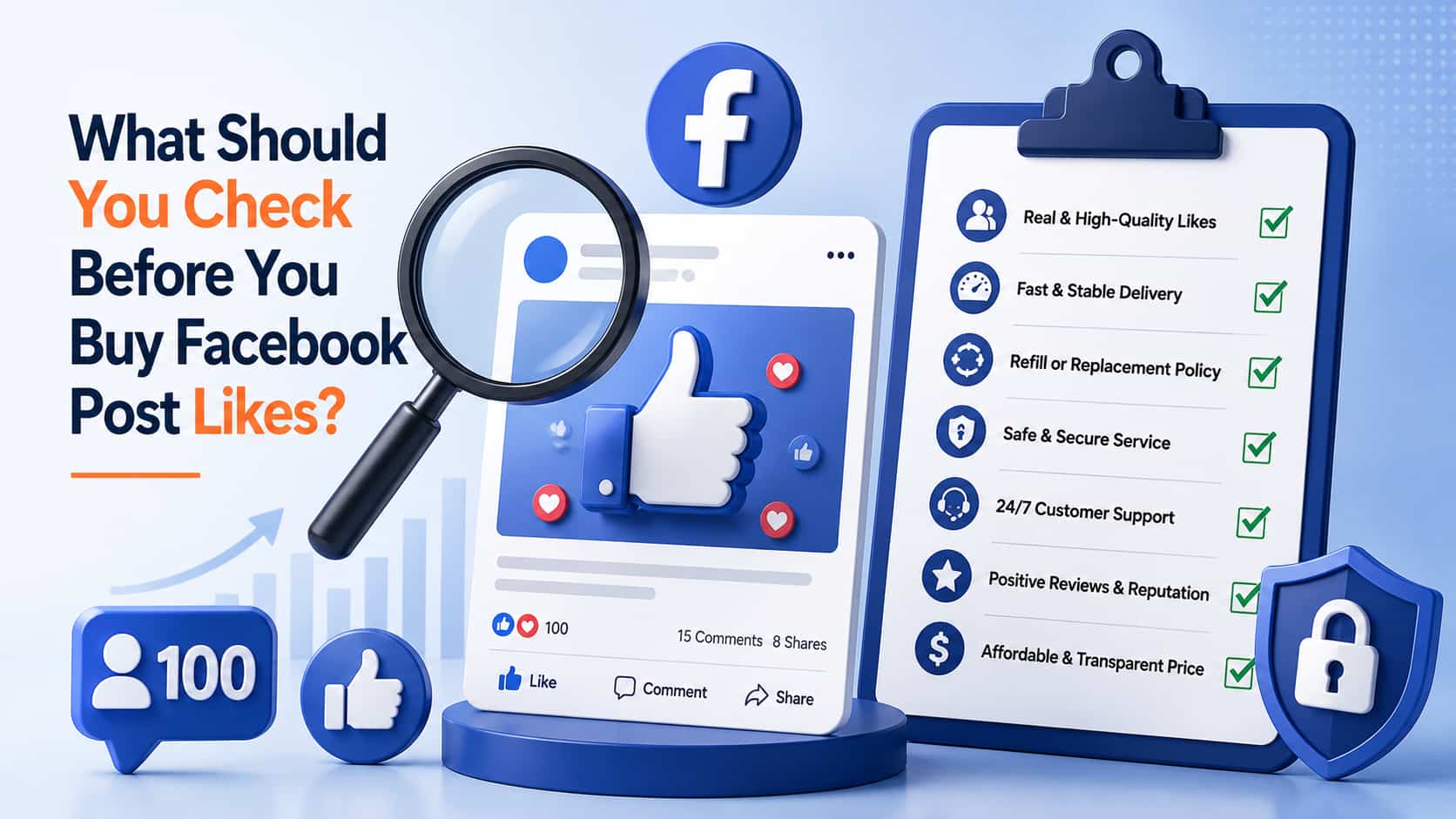
The quantity is only one part of an order. Service details matter because two packages offering the same number of likes can differ in delivery method, retention expectations, start time, pricing, support, and order requirements.
Before purchasing, review the following areas carefully.
1. Correct Facebook Service
Confirm that the service specifically supports Facebook post likes rather than page likes, followers, video views, or reactions.
SMM panel often list multiple Facebook services together. Selecting the wrong service may produce a completely different result from the one you intended.
2. Public Post Requirement
A provider normally needs the public URL of the Facebook content being promoted. You should confirm that the post can be viewed publicly before submitting it.
SMMXZ’s Facebook likes guide advises users not to provide their Facebook password to a likes service and states that a public page or post link should be sufficient for this type of order.
3. Delivery Information
Some buyers specifically search for buy Facebook post likes instant delivery, but “instant” should not be interpreted as a guarantee that every order will finish at exactly the same speed.
Read the service description for start time, estimated delivery, quantity limits, and other conditions. A clearly explained delivery process is more useful than an unrealistic speed promise.
4. Retention or Refill Conditions
Engagement services can differ in stability. Before placing an order, determine whether the service description says anything about retention, refill availability, or expected drops.
This is particularly important when the post will remain visible for a long time.
5. Support Availability
Problems can occasionally occur with incorrect links, delayed orders, unavailable posts, or service changes. A provider with an accessible support system makes these situations easier to manage.
These checks become even more important when comparing cheap packages.
Cheap Facebook Post Likes: Price Is Only One Part of the Decision
Low prices naturally attract buyers, especially when someone only wants to test a small order. But selecting cheap Facebook post likes purely because they have the lowest price can overlook other details that determine whether the purchase is useful.
SMMXZ’s guide to cheap Facebook SMM panel services similarly notes that Facebook panels can offer several types of engagement from one dashboard, making service selection just as important as the headline price.
When comparing providers, consider:
- Total price for the selected quantity
- Minimum order requirement
- Delivery estimate
- Service description
- Retention expectations
- Refill policy, when available
- Customer support
- Payment convenience
- Whether the service matches the correct Facebook content type
The cheapest option may be fine for a low-risk test. For an important client campaign or business post, service clarity and stability may deserve more weight than saving a very small amount.
That naturally leads to another common buyer question: what should 100 likes actually cost?
How Much Does It Cost to Buy 100 Facebook Likes?
There is no universal price for 100 Facebook post likes. Different providers can set different rates according to their service source, delivery model, targeting options, quality category, refill terms, payment processing, and other conditions.
Current search results also show substantial price differences among providers offering 100-like packages, reinforcing why a single market-wide price cannot accurately represent every service.
Instead of asking only, “how much does it cost to buy 100 Facebook likes?”, compare what the price includes.
| Pricing Factor | Why It Matters |
|---|---|
| Quantity | Larger packages may use different unit pricing |
| Service Type | Post likes and page likes are different products |
| Delivery Method | Delivery expectations can affect pricing |
| Retention | More stable packages may cost differently |
| Refill Terms | Some services include refill conditions |
| Location/Targeting | Geographic options can change pricing |
| Provider | Every platform has its own rate structure |
For a 100-like order, even a small pricing difference should be considered alongside reliability. Saving money has little value if the wrong service is selected or the order does not match your objective.
Is It Safe to Buy Facebook Post Likes?
When people ask is it safe to buy Facebook post likes, there are two different issues to consider: account security and platform risk.
From an account-security perspective, you should never give an unknown engagement website your Facebook password, login code, or sensitive account credentials. Using only a public post link avoids unnecessary credential exposure. SMMXZ makes the same recommendation in its Facebook likes guidance.
Platform policies are another consideration. Meta’s monetization rules, for example, identify fake engagement as a potential problem for creators and publishers, meaning artificially generated engagement should not be presented as equivalent to genuine audience activity.
A cautious approach therefore includes:
- Never sharing your Facebook password
- Using a public post URL only
- Reading the complete service description
- Avoiding unrealistic promises
- Starting with a reasonable quantity
- Monitoring the post after delivery
- Continuing genuine content and audience-building efforts
- Avoiding reliance on purchased metrics for monetization or performance claims
The goal should be controlled use as part of a larger marketing approach, not manufacturing a misleading picture of actual customer demand.
Why 100 Likes Can Be a Better Starting Point Than a Huge Order
A common mistake is assuming that more engagement automatically creates a better result. For small pages, however, sudden large numbers can look disconnected from the rest of the account.
Starting with 100 allows you to observe the service and the appearance of the post before increasing the quantity. It can be especially useful when testing a new provider or comparing different service categories.
A smaller first order lets you check:
- Whether the correct post received engagement.
- How quickly delivery began.
- Whether the quantity was completed.
- How the likes look alongside existing engagement.
- Whether the service remains stable.
- Whether support is responsive if something goes wrong.
Once those points have been evaluated, future orders can be based on evidence rather than guesswork.
Prepare the Post Before Adding Likes
Engagement cannot rescue a weak post. If a visitor opens the content and sees an unclear image, incomplete description, poor offer, or no reason to interact, additional likes alone are unlikely to produce meaningful results.
Before placing an order, make sure the Facebook post itself is worth promoting.
Check the following:
- Use a clear image or video.
- Write a readable opening line.
- Explain the offer or message quickly.
- Include important product or service details.
- Add a relevant call to action.
- Reply to legitimate comments.
- Keep contact information accurate.
- Make sure the page profile looks complete.
The broader Facebook page optimization process is especially important for business pages because users may move from the promoted post to the main profile before deciding whether they trust the business.
After the foundation is ready, post likes can be combined with other engagement methods more naturally.
Combine Post Likes With a Wider Facebook Engagement Strategy
One metric rarely tells the whole story. A post with likes but no useful content, comments, clicks, shares, or audience response may appear active without actually contributing much to the business.
A broader Facebook post engagement service strategy can include likes alongside reactions, comments, shares, content improvements, and organic interaction. SMMXZ’s related guide also emphasizes using engagement services as support rather than as a replacement for content and customer interaction.
For example, a business might:
Step 1: Publish a strong product post.
Step 2: Add an initial amount of post engagement.
Step 3: Reply to genuine questions and comments.
Step 4: Share the post with existing audiences.
Step 5: Use video, stories, or additional content to bring people back to the page.
Step 6: Track clicks, messages, inquiries, and sales rather than monitoring likes alone.
For businesses looking beyond a single post, a structured Facebook page promotion strategy can connect individual content campaigns with longer-term page development.
What Metrics Should You Check After Buying Likes?
The order should not be considered finished simply because the number increased. Measuring what happens afterward helps determine whether supporting that particular post made sense.
Track both delivery and marketing indicators.
| Metric | What It Tells You |
|---|---|
| Likes Delivered | Whether the order reached the requested quantity |
| Retention | Whether the engagement remains reasonably stable |
| Organic Comments | Whether people are actually joining the conversation |
| Shares | Whether users consider the content worth distributing |
| Post Reach | How many people Facebook reports the content reached |
| Link Clicks | Whether the post creates website interest |
| Messages | Whether customers start conversations |
| Leads/Sales | Whether the campaign contributes to business results |
The most valuable metric depends on the campaign. An ecommerce seller may care about Messenger inquiries, while a blogger may prioritize link clicks and a creator may watch organic comments or shares.
This prevents the like count from becoming the only measure of success.
Common Mistakes When Buying Facebook Likes for a Post
A small package is simple to order, but several avoidable mistakes can reduce its usefulness. Most happen when people make the purchase before checking the post, provider, or service description.
Ordering Page Likes Instead of Post Likes
Always verify the service name. Page likes and post likes affect different Facebook properties.
Sending the Wrong URL
Open the exact post you want to promote and copy its public link rather than automatically submitting your page homepage.
Buying Before Optimizing the Page
Someone impressed by a post may visit the page next. An incomplete page can undermine the social proof created by the engagement.
Choosing Based Only on Price
Cheap does not automatically mean bad, but price should be compared with service details, delivery, retention conditions, and support.
Expecting Likes to Create Sales Automatically
Likes may affect the visible appearance of a post, but purchases still depend on product quality, pricing, trust, targeting, customer service, and the strength of the offer.
Adding Too Much Engagement Without Context
The quantity should fit the existing size and normal activity of the page. Controlled testing makes it easier to assess what works.
Avoiding these mistakes makes it much easier to decide whether another order is worthwhile.
Why SMMXZ Is the Best Platform to Buy 100 Facebook Post Likes?
When you want to buy 100 Facebook post likes, SMMXZ offers a practical combination of competitive pricing, fast service, simple ordering, and customer support. Instead of focusing only on low prices, SMMXZ aims to make the entire ordering process convenient for users who want to promote a specific Facebook post.
Competitive Pricing Without Compromising Convenience
SMMXZ keeps its Facebook engagement services competitively priced, making a 100-like package suitable for small businesses, creators, marketers, and first-time buyers who want to test a service without spending heavily.
Faster and Easier Service
The ordering process is designed to be simple. Users can select the appropriate Facebook service, provide their public post URL, choose the required quantity, and place the order without sharing their Facebook password.
Why choose SMMXZ?
- Competitive pricing for Facebook post likes
- Fast service with efficient order processing
- Simple and user-friendly ordering system
- Multiple Facebook engagement services in one platform
- Customer support for order-related issues
- Suitable for both small tests and larger marketing campaigns
For buyers who value price, speed, convenience, and service support, SMMXZ provides a balanced option for purchasing 100 Facebook post likes.
Final Thoughts
A 100-like package can make sense for someone who wants to start small, support a selected piece of content, or test a Facebook engagement service before committing to a larger quantity. It is particularly useful when the number is reasonably aligned with the page's existing activity.
The stronger approach is to treat paid engagement as a supporting tactic. Optimize the page, create worthwhile posts, interact with real users, track business metrics, and understand exactly what the provider is offering before placing an order.
If your objective is a controlled starting point rather than an oversized engagement spike, you may choose to buy 100 Facebook post likes while continuing to build genuine Facebook visibility around the content.